
Find Hawaii Dissolution of Marriage Records
Hawaii dissolution of marriage records are official court documents filed with the Family Court in the judicial circuit where the case was heard. The state operates five circuits, each running its own Family Court with full jurisdiction over all divorce proceedings. You can search basic case information online through the Hawaii State Judiciary's free public portals, or request certified copies directly from the court clerk. Whether you need to verify a marriage ended, review a prior decree, or obtain documents for legal purposes, this guide explains where to look and how to get the records you need.
Hawaii Dissolution of Marriage Overview
Where to Find Hawaii Dissolution of Marriage Records
In Hawaii, all dissolution of marriage cases go through the Family Court system. The Hawaii State Judiciary Family Court operates across five judicial circuits. First Circuit Family Court serves Oahu and is located at the Kapolei Judiciary Complex, 4675 Kapolei Parkway, Kapolei, HI 96707, phone (808) 954-8000. Second Circuit Family Court serves Maui, Lanai, and Molokai and sits at Hoapili Hale, 2145 Main Street, Wailuku, HI 96793, phone (808) 244-2700. Third Circuit serves Hawaii Island with two divisions: Hilo at 777 Kilauea Avenue, phone (808) 961-7500, and Kona at 74-5451 Kamakaeha Avenue, phone (808) 322-8700. Fifth Circuit Family Court serves Kauai at 3970 Kaana Street, Lihue, HI 96766, phone (808) 482-2330. The Family Court in each circuit keeps the full case file for every dissolution of marriage filed in that area.
The Hawaii Department of Health holds a narrow set of dissolution records. The DOH Office of Health Status Monitoring, located at 1250 Punchbowl Street Room 103 in Honolulu, maintains certified divorce certificates only for events occurring from July 1951 to December 2002. Effective February 1, 2026, the Department will no longer maintain records of divorce. If the dissolution you are researching happened outside that window, go directly to the Family Court where the case was filed. The DOH office is open Monday through Friday, 7:45 a.m. to 2:30 p.m., with appointments encouraged though walk-in service is available.
Historical dissolution records go back further through the Hawaii State Archives, located at 364 S. King Street, Honolulu, phone (808) 586-0329. These records cover the First Circuit from 1848 to 1892, the Second Circuit from 1848 to 1900 and 1915, the Third Circuit from 1854 to 1899, and the Fifth Circuit from 1852 to 1899. All have been microfilmed and a portion are accessible through the Archives' digital collections.
The screen below is from the Hawaii State Judiciary Family Court page, listing all circuit locations and contact information.
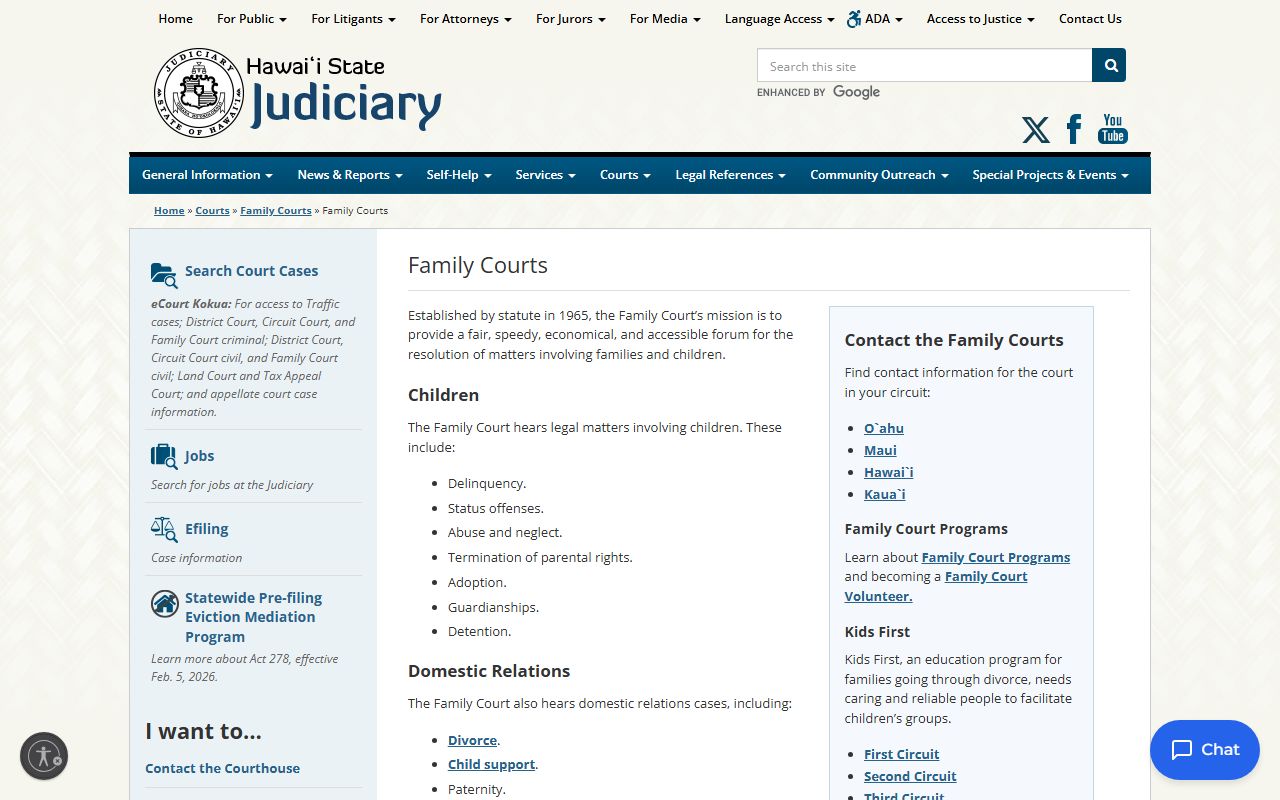
The Family Court hears all dissolution of marriage cases and handles related matters such as property division, child custody, child support, and spousal support.
How to Search Hawaii Dissolution Records Online
The Hawaii State Judiciary provides two primary online tools for searching dissolution of marriage records. The first is eCourt Kokua, which gives free access to public information from traffic cases, District and Circuit Court criminal and civil cases, Family Court adult criminal cases, Land Court, Tax Appeal Court, and appellate cases. No registration is required. The second tool, Ho'ohiki, specifically covers Family Court civil cases from 1983 to present, including dissolution of marriage cases. Ho'ohiki lets you search by case ID, party name, or by circuit, case type, year, and sequence number. Together these two systems give broad access to Hawaii dissolution records without a trip to the courthouse.
Both systems update every evening. Data is generally current to within 48 hours of when a court document is filed or a proceeding is heard. The online portals display party names, case status, filing dates, hearing dates, and docket entries. Confidential cases, sealed cases, and sealed documents are not available online. Personal identifying information such as Social Security numbers is not shown in the public access portions. If private information appears in evidence or pleadings that are part of the public record, that material is available in paper form at the courthouse.
Documents can be purchased through eCourt Kokua. Downloads cost $3.00 per document for 1 to 30 pages, with each additional page costing $0.10. Non-refundable subscriptions are available at $125 per quarter or $500 per year for unlimited single downloads of public documents that have a PDF icon in the docket.
The screenshot below shows the Hawaii State Judiciary court records search portal that gives access to dissolution of marriage case information statewide.
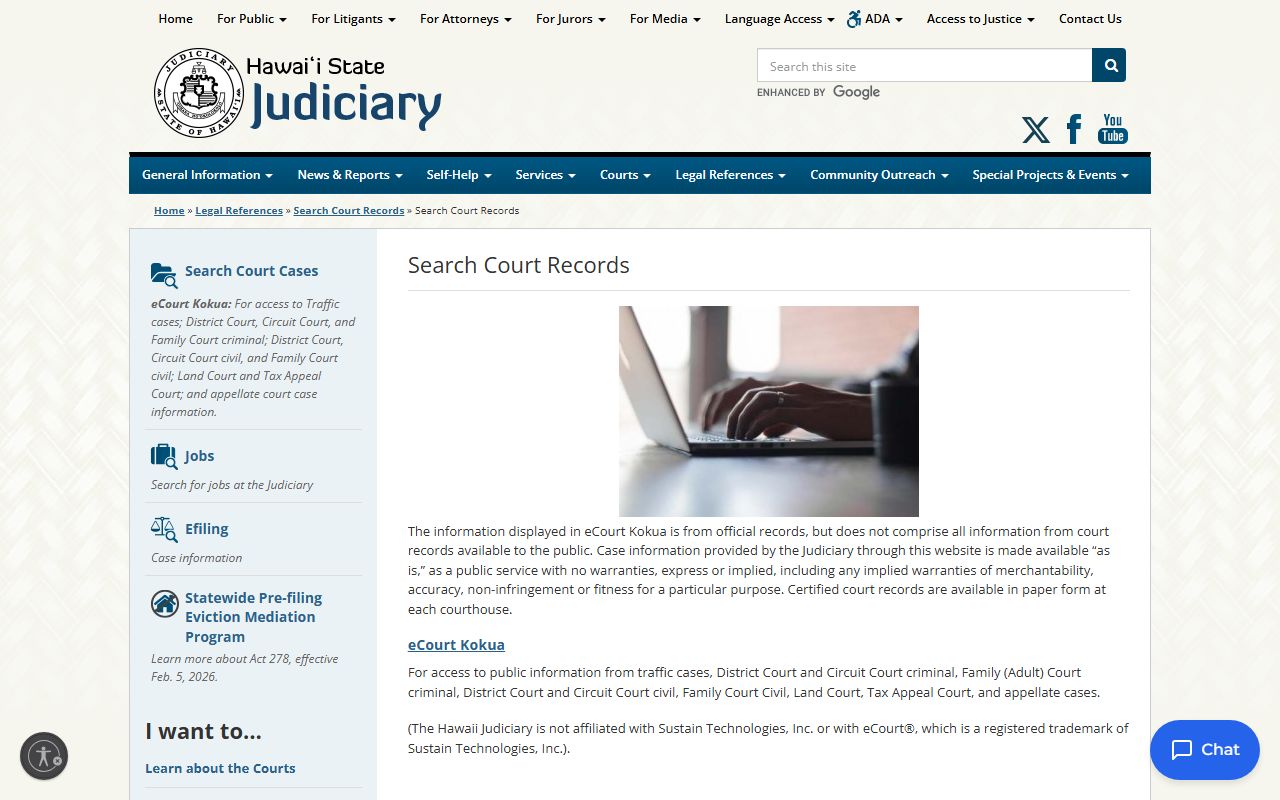
The portal covers Circuit, District, and Family Court civil and criminal records from courts in all five circuits.
Understanding Hawaii Case Numbers for Dissolution Searches
Knowing the case number format makes searching dissolution of marriage records in Hawaii much faster. The Judiciary Information Management System (JIMS) uses a specific structure. Case numbers include the circuit number, a character for the court type, the two-letter case type code, a dash, the two-digit year, a dash, and the sequence number. For example, a First Circuit Family Court dissolution case might look like 1FDV-22-0000001. You can drop leading zeros when searching. Family Court civil cases include codes such as UF for uncontested family matters and DV for domestic violence cases.
Civil cases created starting October 7, 2019 can be searched by entering the full case ID with hyphens. For older cases, the search interface accepts partial information including just party names and a year range. When you do not have the case number, searching by full name of one or both parties is usually enough to find the record. The JIMS system availability page explains all active case types and how to interpret what you see in search results.
The screenshot below is from the JIMS system availability guide, which lists case number formats used across Hawaii courts.
The JIMS guide is useful when you have a partial case number or are trying to understand the format of records found in eCourt Kokua.
Accessing Dissolution Records Through eCourt Kokua
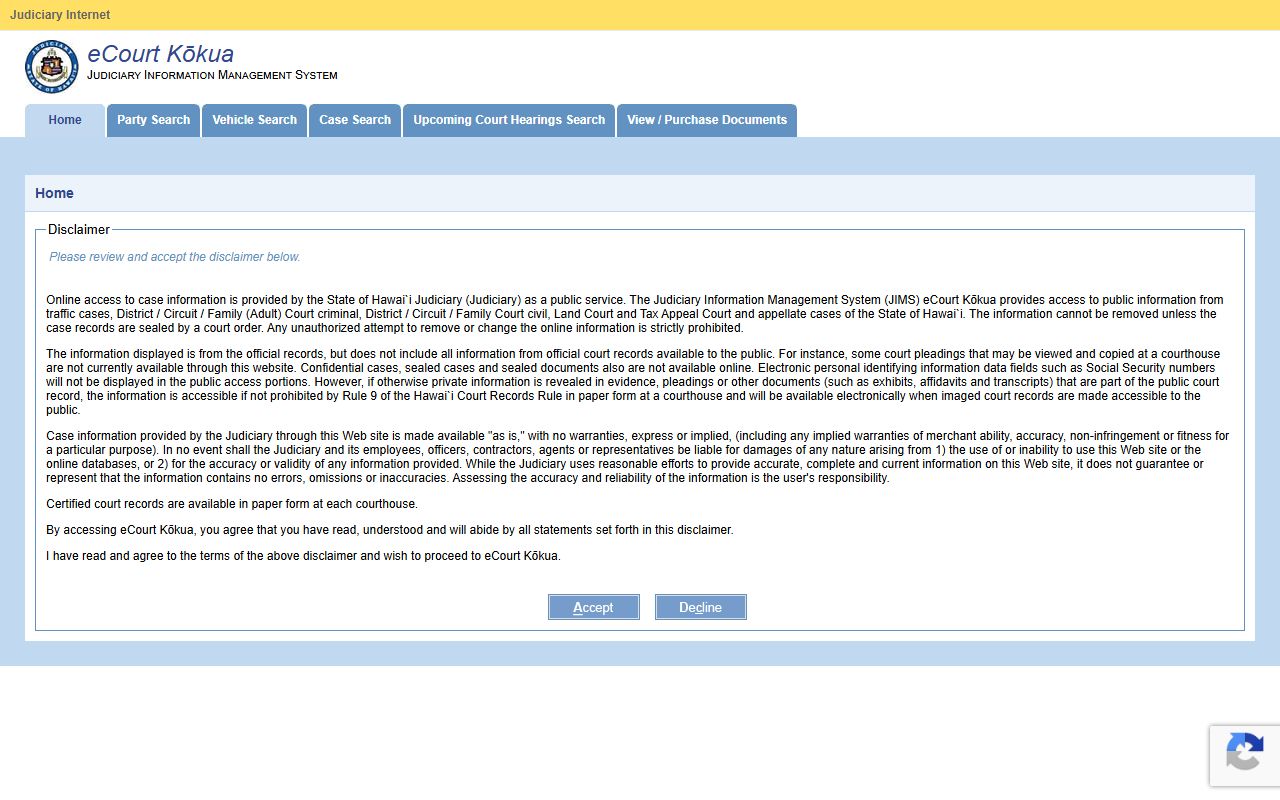
eCourt Kokua is the public-facing access point for the JIMS system. Before searching, users must review and accept the system's terms. Case information is provided "as is" without warranties. The Judiciary and its staff are not liable for errors, omissions, or inaccuracies in the data. Accuracy and reliability checking is the user's responsibility. Some court pleadings viewable at courthouses are not available through the website. Electronic personal identifying information such as Social Security numbers is not shown in the public portions. If private information appears in public-record evidence or pleadings, it is accessible in paper form at the courthouse and electronically when imaged records are made available.
For cases not found online or where documents are not available in PDF form, call the courthouse directly before visiting. The First Circuit Legal Documents Branch 2 is at 1111 Alakea Street, Honolulu, phone 808-538-5149, email LDB2.1DC@courts.hawaii.gov, open 8 a.m. to 1 p.m. Monday through Friday except state holidays. Public access computer terminals are available at multiple courthouse locations statewide during regular business hours.
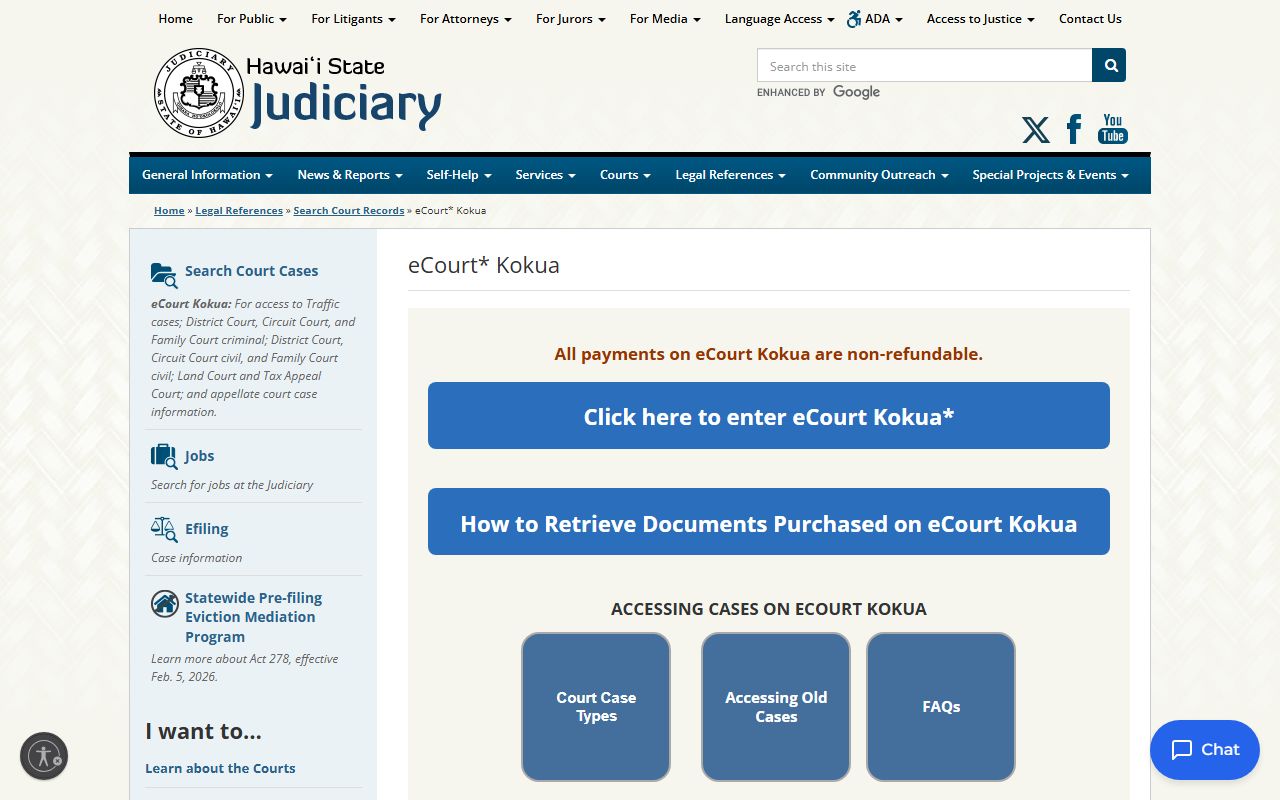
The screenshot below shows the eCourt Kokua portal interface used to search Hawaii dissolution of marriage case records.
eCourt Kokua covers traffic, criminal, civil, and family court cases from all five circuits and is free to search with no account required.
What Hawaii Dissolution of Marriage Records Contain
A dissolution of marriage case file in Hawaii holds several documents. The complaint for divorce is the first paper filed, stating the grounds and what the petitioner is requesting. An automatic restraining order comes with the complaint, preventing either party from moving assets or taking children out of state during the proceedings. The answer from the other spouse may be filed if the case is contested. Financial affidavits like the Income and Expense Statement (Form 1F-P-081) and the Asset and Debt Statement (Form 1F-P-063) detail each party's financial picture. All of this becomes part of the public court file at the Family Court.
Most people seeking dissolution of marriage records need the divorce decree. Hawaii Family Courts use separate decree forms depending on whether minor children are involved. The decree covers all final terms: property division, alimony provisions, child custody arrangements, visitation schedules, and child support. Both contested and uncontested cases end with a signed and filed decree. Certified copies of the decree are required for name changes, updating beneficiary designations, proving marital status to a government agency, or handling estate matters.
Dissolution records at the Family Court typically include:
- Complaint for Divorce with Automatic Restraining Order and Summons
- Matrimonial Action Information form
- Proof of Service or Appearance and Waiver signed by the other party
- Income and Expense Statement and Asset and Debt Statement
- Notice to Attend Kids First (when children are involved)
- Divorce Decree with all final orders
- Child custody and support orders if applicable
Per Hawaii Court Records Rules, only adult family court records are open to the public. Juvenile family court records are sealed by statute. Personal identifying information such as Social Security numbers, tax details, and account numbers is classified as confidential information and is generally redacted from publicly accessible records.
The screenshot below is from the Hawaii State Judiciary divorce self-help page, which explains the dissolution process and what documents are involved.
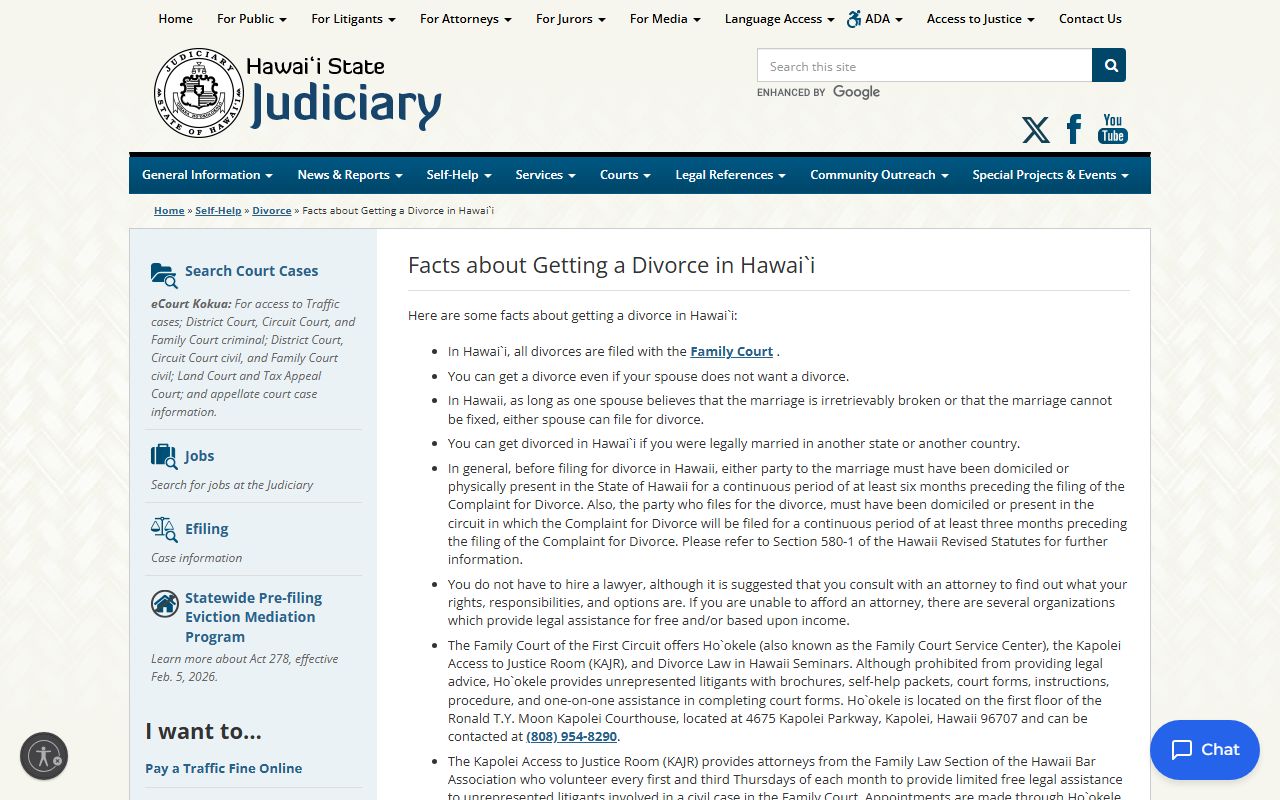
The Judiciary offers free uncontested divorce forms through its self-help section and holds monthly public seminars on dissolution of marriage law in Hawaii.
Hawaii Dissolution of Marriage Law and Requirements
Hawaii dissolution of marriage proceedings are governed by Hawaii Revised Statutes Chapter 580. Under Section 580-1, exclusive original jurisdiction over dissolution matters rests with the Family Court of the circuit where the applicant is domiciled when the application is filed. People living on any military or federal base, installation, or reservation in the state, or those present in Hawaii under military orders, are not prohibited from meeting residency requirements. The Family Court of each circuit also has jurisdiction over all proceedings relating to the annulment, dissolution, and separation of civil unions.
Hawaii is a no-fault state. You do not need your spouse's consent to file. You do not have to state a specific reason for wanting a divorce. Section 580-41 sets the grounds for dissolution. A court may grant it when the marriage is found to be irretrievably broken. Other grounds include parties living separate and apart under a decree of separation for the required term, or living separately for a continuous period of two years or more immediately before filing, with no reasonable likelihood of cohabitation resuming. You can get a divorce in Hawaii even if you were married in another state or another country.
The residency requirement is six months of living in Hawaii before filing. This applies to military personnel stationed here as well as legal residents of other states or countries who have relocated. Monthly "Divorce Law in Hawaii" public education seminars cover custody, property division, child support, alimony, and the difference between contested and uncontested dissolution. The Judiciary also provides comprehensive self-help forms for uncontested cases at no charge through the Family Court Service Center in each circuit.
The image below is from the Hawaii Revised Statutes Chapter 580 page, which contains the full text of Hawaii's dissolution of marriage laws.
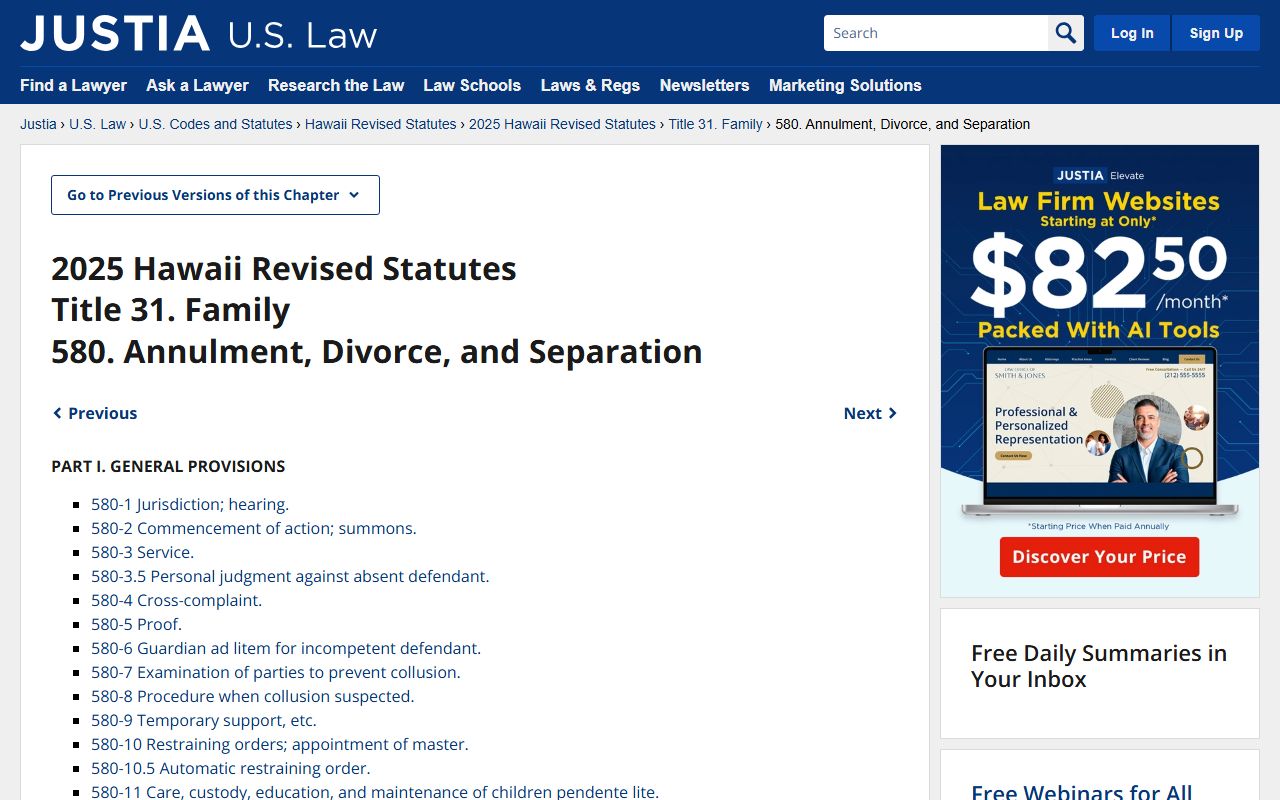
Chapter 580 covers jurisdiction, residency rules, grounds for dissolution, and all procedural requirements for terminating a marriage in Hawaii.
Divorce Certificates from the Hawaii Department of Health
If you need a certified divorce certificate and the dissolution occurred between July 1951 and December 2002, the Hawaii Department of Health can provide one. The DOH is clear on its form: this office only has established divorce records from July 1951 to December 2002. All other dissolution records are kept in the court where the case was filed. If your date falls outside that range, contact the Family Court directly.
Fees are $10 for the first certified copy and $4 for each additional copy of the same record. A portal administration fee of $2.50 applies to online orders. All transactions are non-refundable. If the vital record is not found, all fees are kept to cover the search cost. Only one name is allowed per request form. Postal mail requests go to: State Department of Health, Office of Health Status Monitoring, Vital Records Issuance Section, PO Box 3378, Honolulu, Hawaii 96801. Do not send cash. Payment must be by money order or cashier's check made payable to Hawaii State Department of Health. Mail processing currently takes 6 to 8 weeks on average.
In-person requests are handled at Room 103, 1250 Punchbowl Street, Honolulu, open Monday through Friday from 7:45 a.m. to 2:30 p.m., except state holidays. Metered parking is available at $2 per hour payable by cash or credit card. Walk-in service is available between appointments as time permits, but appointments are encouraged. For neighbor islands, contact your local District Health Office.
Note: Effective February 1, 2026, the Hawaii Department of Health will no longer maintain records of divorce. Researchers and legal professionals should contact the Family Court directly for dissolution of marriage records going forward.
The image below is from the Hawaii Department of Health Vital Records page where divorce certificates from 1951 to 2002 can be ordered.
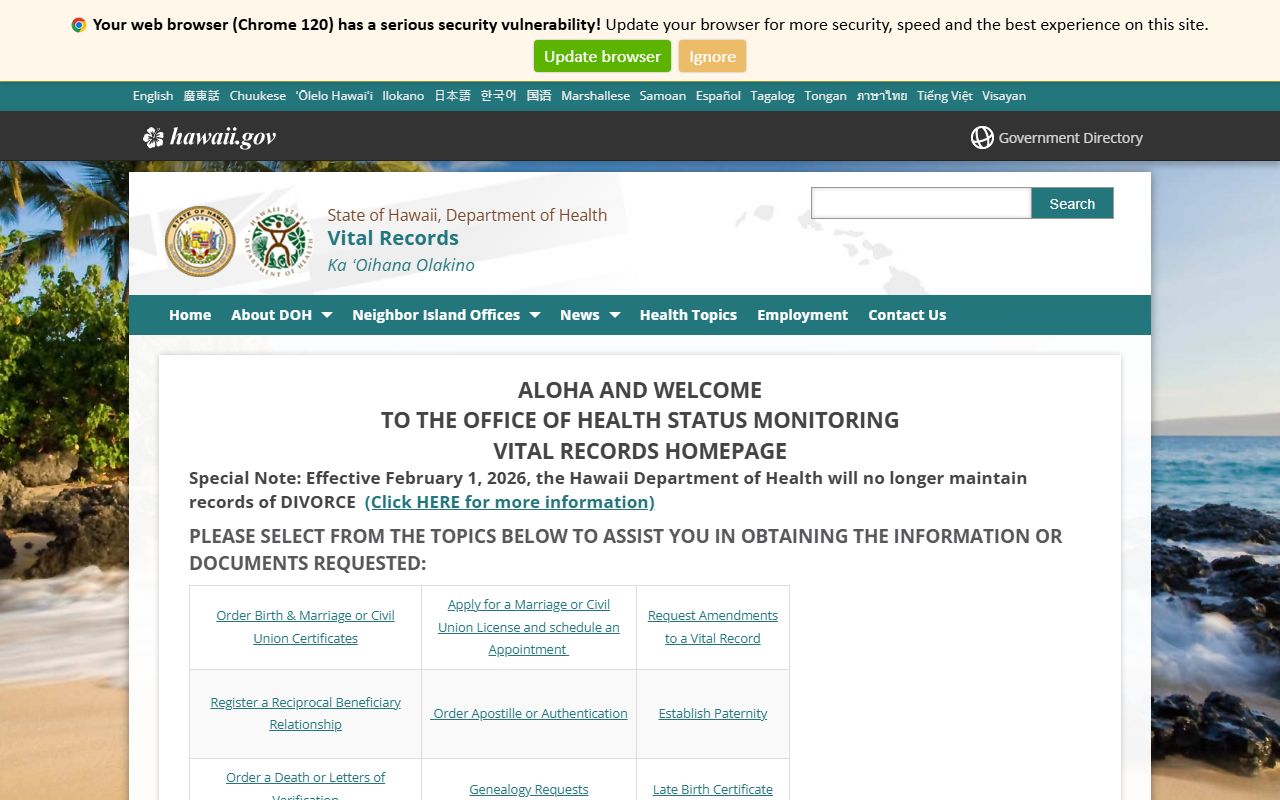
The DOH office at 1250 Punchbowl Street handles both in-person and mail requests for certified divorce records from the 1951 to 2002 period.
Historical Hawaii Dissolution Records at the State Archives
The Hawaii State Archives holds original dissolution of marriage case files going back to the mid-1800s. The genealogy research guide published by the Archives identifies divorce case files as one of the key record types available to researchers. Genealogists, historians, attorneys, and family researchers regularly use this collection. The mission of the Digital Archives project is to develop a digital repository capable of providing reliable long-term access to these trustworthy records for the public and government entities.
Coverage by circuit: First Circuit Court (Oahu) 1848 to 1892, cases 1 through 2415, cataloged on microfilm MFL 51; Second Circuit Court (Maui) 1848 to 1900 and 1915, cases A1 through A319, microfilm MFL 54; Third Circuit Court (Hawaii Island) 1854 to 1899, cases 1 through 424, microfilm MFL 56; Fifth Circuit Court (Kauai) 1852 to 1899, cases 1 through 206, microfilm MFL 60. Some documents are in Hawaiian and English, with court and Archives translators having provided English translations for Hawaiian-language materials. Note that case file 2147 in the First Circuit collection was not transferred to the Archives.
Case files from this era typically contain an application for divorce, a summons, an affidavit of publication of the divorce notice, the divorce decree, statements from the husband or wife, and the full divorce proceedings. Information includes the date of marriage, place of residence, the circumstances and reasons for filing, children involved, and fees paid to the court. Minutes to cases are found in the Civil and Criminal Minute Books for each circuit. The Hawaii State Archives Digital Archives project has digitized portions of the First Circuit collection and makes them browsable online.
The screenshot below shows the Hawaii State Archives genealogy research guide, which explains how to access historical dissolution of marriage records.
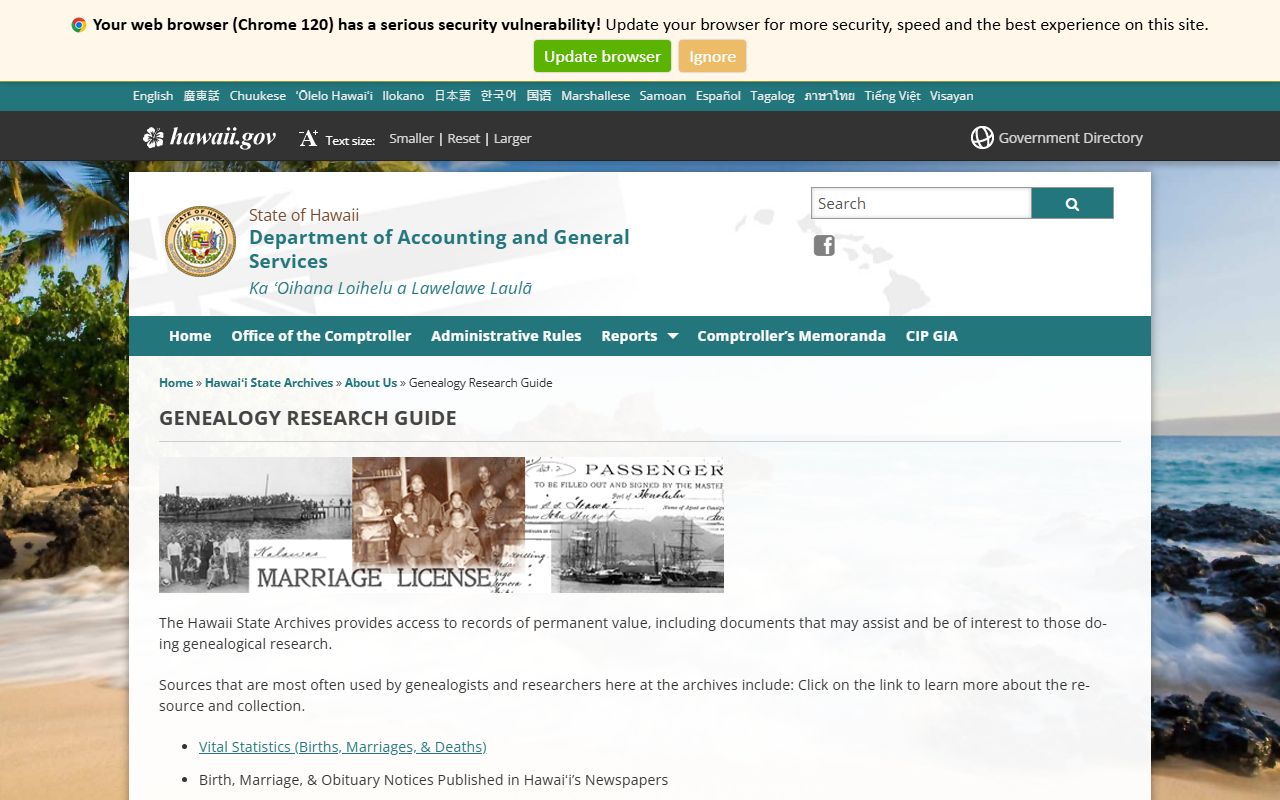
The Archives also maintains indexes for some circuits that allow researchers to search by name before requesting the full case file for review.
The Digital Archives project screenshot below shows the collection page for historical dissolution records from the First Circuit.
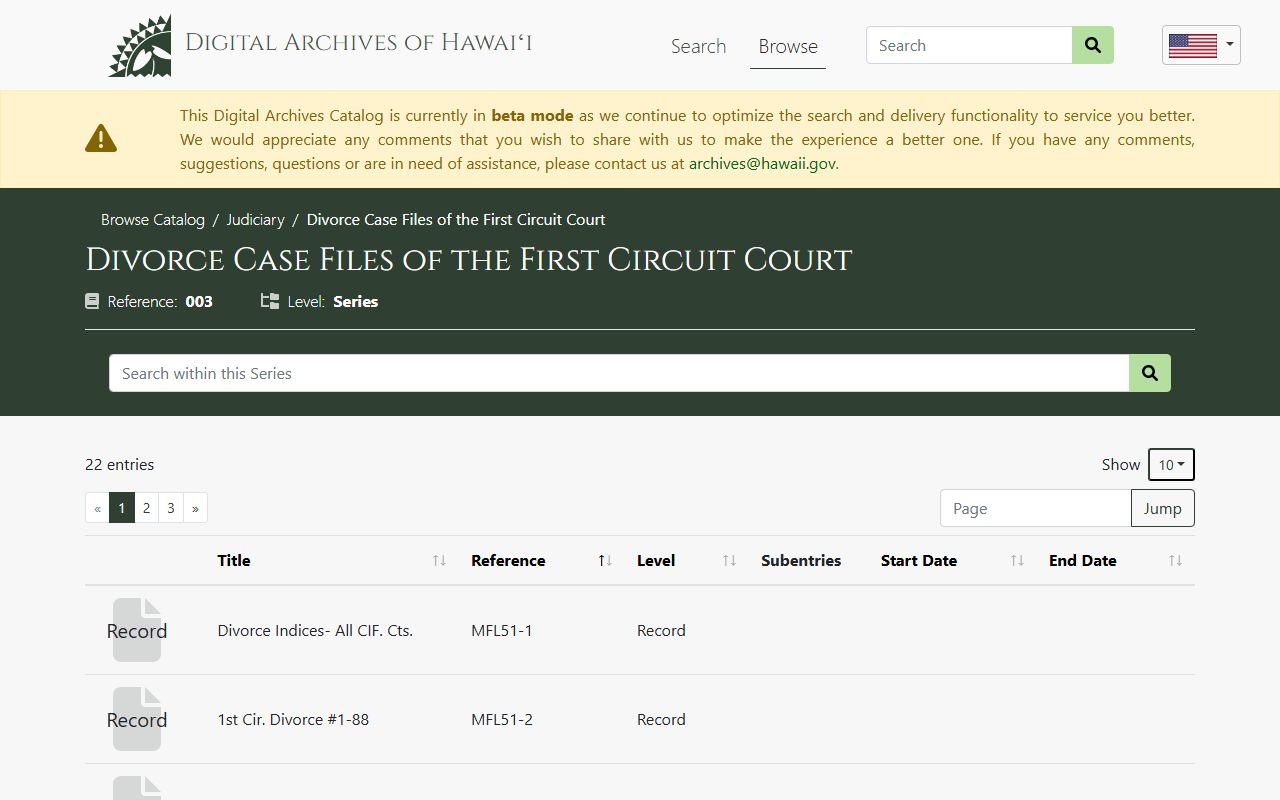
The digital repository protects records from loss, alteration, and technological obsolescence, ensuring access for current and future researchers.
Browse Hawaii Dissolution of Marriage Records by County
Each of Hawaii's five counties has a Family Court that handles dissolution of marriage filings. Pick a county below to find local court contact information, filing procedures, and resources for that area.
Dissolution of Marriage Records in Major Hawaii Cities
Residents of major Hawaii cities file for dissolution of marriage at the Family Court in their circuit. Pick a city below to find court information and resources specific to that location.